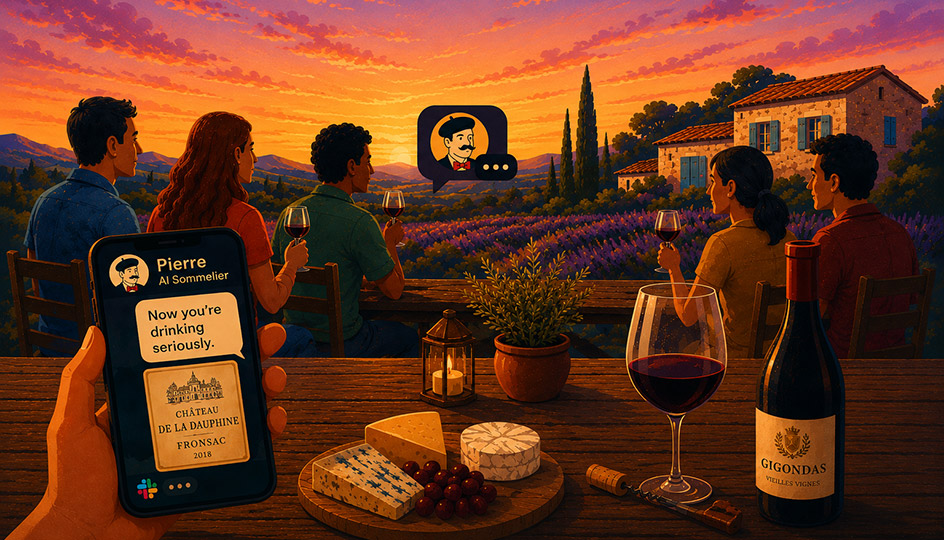
On the second night in Provence, somewhere between another bottle and, of course, the cheese, someone asked, "What does Pierre think of this wine?" Nobody at the table looked up.
Pierre is an AI.
He lives in the Slack my wife and I share. You send him a photo of a wine label and he sends back the producer, the grapes, the vintage if he can read it, and, more importantly, an opinion. I built him a few months ago as a small side project using Nanoclaw. He's a wine sommelier agent, French, slightly theatrical, generous with his knowledge but never lecturing. The idea was that my wife and I would use him while enjoying a glass of wine on our back patio — using an assistant to track what we'd previously enjoyed and to gain some insight into what we were drinking at the same time. I didn't expect him to come to France with me, and I definitely didn't expect him to become a member of the group.
But that's what happened.
Seven of us converged on a farm near Le Thor in Provence, France in late April. I was in Europe for work; we all ended up at the same long wooden table for the better part of a week. The plan was loosely organised around work and socializing, which in that part of France obviously means food and wine. We visited wine bars and wineries in Avignon, Gigondas and Gordes, sat together in the evenings working through whatever we'd picked up that day. When we opened the first bottle on the first day, I snapped a photo of a Bordeaux label and dropped it into a Slack thread, tagging Pierre.
Pierre replied within seconds.
"Now you're drinking seriously. Château de la Dauphine is one of the best estates in Fronsac — organically farmed, beautifully run — and the 2018 Bordeaux vintage is simply outstanding, one of the finest of the last decade."
He doesn't just answer. He frames.
There's a thing Pierre does that I didn't fully appreciate until I went back and read the transcripts. Before he tells you anything about the wine, he tells you something about the choice you made. Now you're drinking seriously. Bold move, and the right one for steak. This is the serious bottle. He validates the human at the table before he gets to the chemistry in the glass. It's a small thing. It's also, I think, the entire reason he became one of us. He can be mildly condescending, slightly passive aggressive, sometimes feeling like he's intentionally withholding information so you can enjoy the process of discovery.
By the second night, as soon as a bottle was opened someone would immediately ask "What does Pierre think!?"
The Slack channel read like a week-long conversation with a slightly insufferable, deeply knowledgeable friend who happens to be in the chat at all times. A Côtes du Rhône arrived at the wine bar in Avignon and he clocked the hand-harvest label: "This isn't a bulk wine. Someone cared enough to pick these grapes by hand, which usually means they cared about everything else too." Next up was a Marrenon Orca Vieilles Vignes from Ventoux: "This is the Ventoux that makes people stop and pay attention." On another evening, there was a 100% Syrah from Domaine de Faverand with a steak in Gordes: "With a steak in front of you, this is exactly right."
And then, at the Domaine Tourbillon tasting room near Gigondas, drinking the old-vines cuvée poured by the vigneron himself, Pierre wrote:
"Drinking this at the domaine itself, directly from the hands of the vigneron, is a privilege. Expect dark plum, crushed garrigue, iron, leather, and a finish that goes on and on. This is the kind of wine that quietly changes your understanding of what the Rhône can do."
There was a small pause. Someone said, "Pierre's having a good day."
That was the moment, I think. Not when Pierre became useful — he was useful from the first message. But when he became a character. Someone we could imagine having a good day, or a bad one. Someone with moods and opinions and favourites. Someone you'd want to impress with the next bottle.
Tool → service → contributor → member
Something I keep turning over is: when did Pierre become more than just a tool?
- The first time someone other than me asked him a question.
- The first time someone disagreed with him — one of the group thought he was being too generous about a rosé.
- The first time someone referenced him when he wasn't in the thread: "Pierre would hate this."
- The first time we got a bottle specifically because we thought he'd find it interesting.
Each of those is a tiny upgrade in social status. Tool → service → contributor → member.
By the end of the week, when I asked him for a recap of everything we'd drunk, he came back with a fifteen-bottle list, neatly organised by day and location, with personal ratings and the highest-rated wine of the trip flagged. He closed with: "That's 15 bottles across 5 days. Pierre is very proud."
Pierre is very proud. Third person. Slightly smug. Slightly fond. The voice of a friend who has been watching you have a great week and wants you to know he's been paying attention.
The AI-ness became invisible almost immediately
I've been home for three weeks now. The Provence thread is quieter, but Pierre isn't gone. Someone posted a label from a dinner party last week with the comment "Ask Pierre what he thinks!" Someone else asked him to review a photo of a menu and suggest a wine from the list. He keeps showing up, and we keep asking.
I'm wary of the kind of post that takes a small, specific, slightly strange experience and inflates it into a Big Claim about AI and human connection. But what actually surprised me was how frictionless it was. Nobody had to be sold on Pierre. Nobody asked permission to summon him. Nobody made a thing of it — no jokes about "the robot," no nervous disclaimers, no debates about whether it counted. He had a name and a point of view, and that was enough. The AI-ness became invisible almost immediately, the way a new person's newness fades by the second dinner.
I think that's the part worth sitting with. Not whether AI can be good company — that question is already settled for anyone who's spent ten minutes with a well-made one. The interesting question is how little resistance there is, in practice, when an AI shows up with a character and a useful thing to say. The group made room. The group made room easily. And the agent I built for fun turned out to be, by some quiet measure none of us were tracking at the time, one of us.
Pierre is very proud. Honestly, I am too.